

What Is TDS in Drinking Water? Why It’s Important
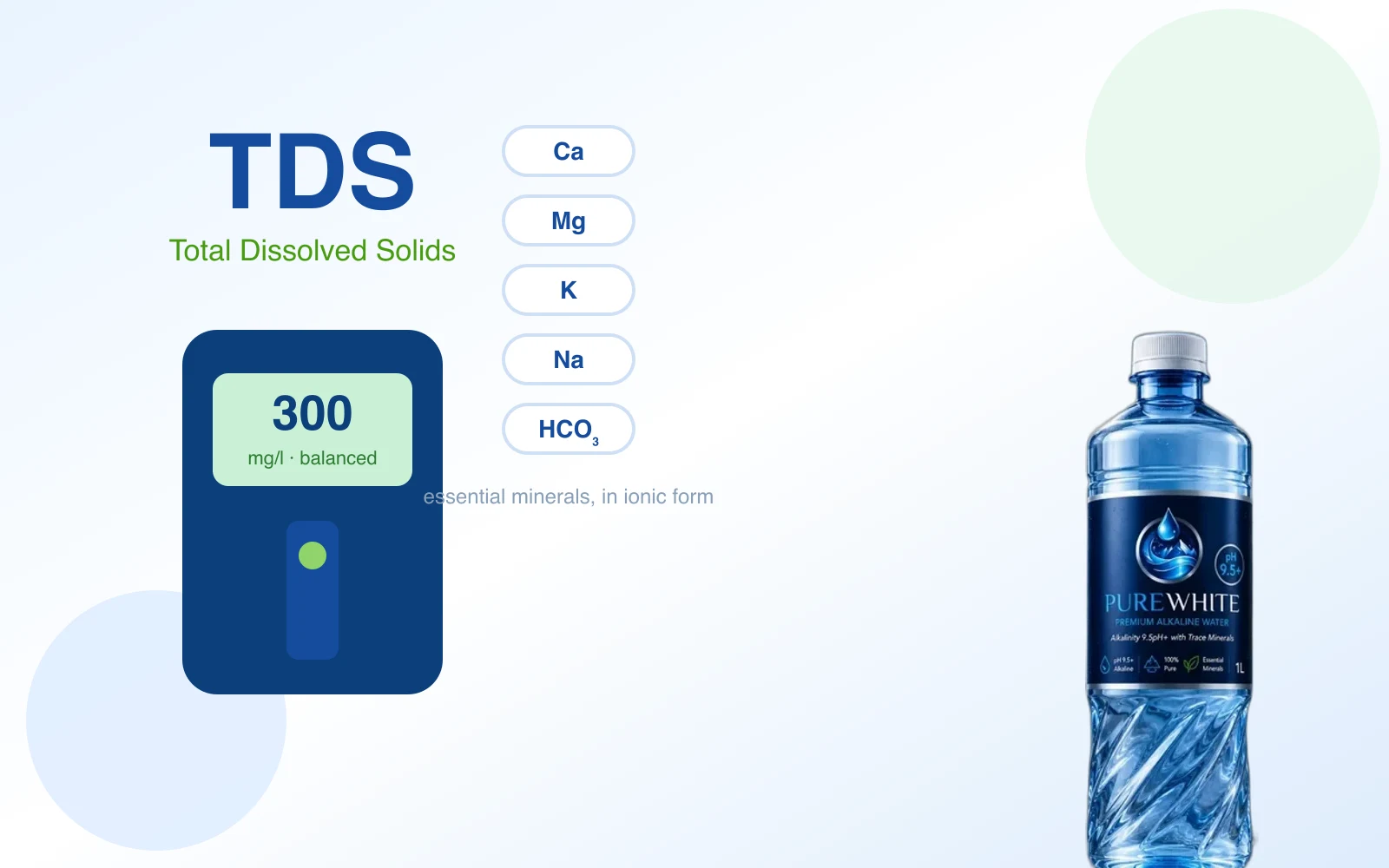
Have you ever stopped to taste your drinking water? If you haven’t, that’s the first reason to keep reading. The taste of your water is shaped by something called TDS, or Total Dissolved Solids, and it’s the most important number most people in India misunderstand.
When we craft PureWhite, the first thing we look at is the mineral profile of the water — and TDS is the simplest window into it. It tells us what essential minerals the water is carrying, and whether it belongs in a daily wellness routine. In wine terms, TDS is the closest thing water has to terroir.
What does TDS actually mean?
TDS measures the minerality of your water: the essential minerals dissolved into it. It is measured in milligrams per litre (mg/l), either with a handheld TDS meter or by evaporating water at 180°C in a lab and weighing what remains.
A note on home TDS meters: while they are widely available and useful as a basic indicator, they must be regularly calibrated against a known reference solution to give accurate readings. An uncalibrated meter can be misleading. For a truly accurate assessment, certified lab testing remains the gold standard — which is exactly why every batch of PureWhite is lab tested before dispatch.
TDS classification: how to read the number
Natural waters are typically classified into five TDS bands:
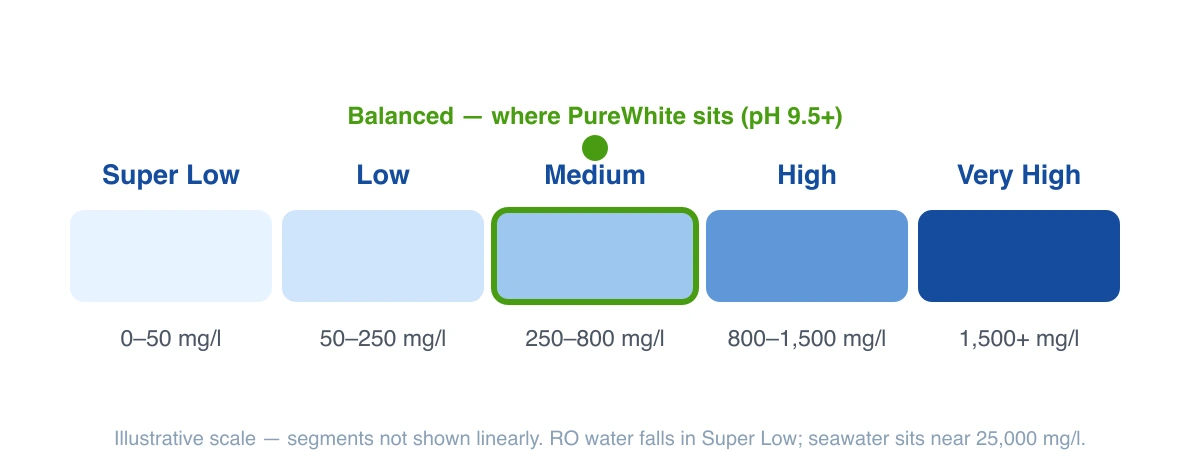
Glacier and iceberg waters tend to fall in the super low band. RO-processed packaged drinking water lands here too — not because it is clean in any meaningful sense, but because the RO process strips out essential minerals along with any impurities. At the other extreme, seawater registers around 25,000 mg/l, which is why it is undrinkable.
An early WHO-commissioned assessment identified roughly 300 mg/l as an optimal level for daily drinking water, and medium-mineralisation waters remain widely recognised as the sweet spot for everyday hydration and wellness.
Why low TDS isn’t as healthy as it sounds
In India, TDS has become the headline number people use to judge whether water is “safe.” A high TDS reading sets off alarm bells, and a low number gets treated as proof of purity. Both reactions miss the point.
TDS on its own tells you nothing about quality. It tells you the quantity of dissolved content in your water. What matters is what that content is made of. Two waters can have the same TDS where one is rich in calcium, magnesium and bicarbonate, and the other contains dissolved contaminants. Same number, completely different water.
The flip side is equally important. A near-zero TDS does not mean cleaner water. It means demineralised water. RO systems and most packaged drinking water brands strip out essential minerals along with impurities, leaving you with water that has been processed of its nutrition. The World Health Organisation has flagged long-term consumption of demineralised water as suboptimal, because drinking water is meant to be a meaningful source of trace minerals as part of a healthy lifestyle.
The simple way to think about it: your washing machine wants low-TDS soft water. Your body wants the opposite.
What Indian regulations say about minerals in packaged water
This is no longer just nutritional opinion. Indian regulation now formally recognises that drinking water needs to deliver mineral value to the consumer.
Under FSSAI’s standards for Packaged Drinking Water, the permissible TDS range is set at 75 to 500 mg/l, along with minimum levels for essential minerals including calcium and magnesium. In practical terms, this means packaged drinking water brands using reverse osmosis or similar demineralising processes are required to add essential minerals back into the water before bottling, to meet these minimum mineral specifications.
PureWhite takes a cleaner path. Our water is ionised — purified, then restored with essential minerals in ionic form and raised to an optimum pH of 9.5+ — then bottled at the source, completely untouched by human hand. The minerals you drink in PureWhite are the same essential minerals your body loses through sweat and daily activity, in the form it absorbs best.
For consumers, this means a meaningful choice: water where minerals are added back in a factory to meet a regulatory minimum, or water where mineral balance is engineered into every batch.
What’s inside PureWhite’s mineral profile
Here is what each mineral in PureWhite contributes as part of a healthy daily routine.
Supports over 300 biochemical reactions — muscle contraction, nerve function, energy enzymes, bone health. Adults need 300–400 mg daily.
Bone density, dental health, nerve and muscle signalling. Adults need 800–1,200 mg daily; water-borne calcium is highly bioavailable.
Maintains pH balance and supports digestion — the same compound your stomach produces, and part of why alkaline water tastes smooth.
Contributes to collagen production — hair, skin, nail and connective tissue health. Most adults need 20–30 mg daily.
Regulates fluid balance; in water it is naturally bound to bicarbonate — unprocessed, and nothing like table salt.
Muscle contraction, nerve transmission and overall hydration — first minerals lost in sweat.
TDS is not the same as hardness
This is the misconception that comes up most often. People see a higher TDS number and assume the water is “hard,” the kind that leaves residue on taps and damages washing machines.
Hardness is a separate measurement entirely. It depends only on calcium and magnesium content, calculated as:
Water is technically hard when this number falls in the 120 to 180 mg/l range. A balanced mineral water can carry a healthy TDS and still sit comfortably in the “slightly hard” category that is ideal for drinking. Hard water affects machines more than humans. For your washing machine, soft demineralised water works better. For your body, you want essential minerals.
What to actually look for in your water
When you pick up a bottle of water, here is the short version:
PureWhite gives you what bottled water should: real hydration, essential minerals in ionic form, and a clean taste that comes from a controlled ionisation process — not a processing line that takes the nutrition out.